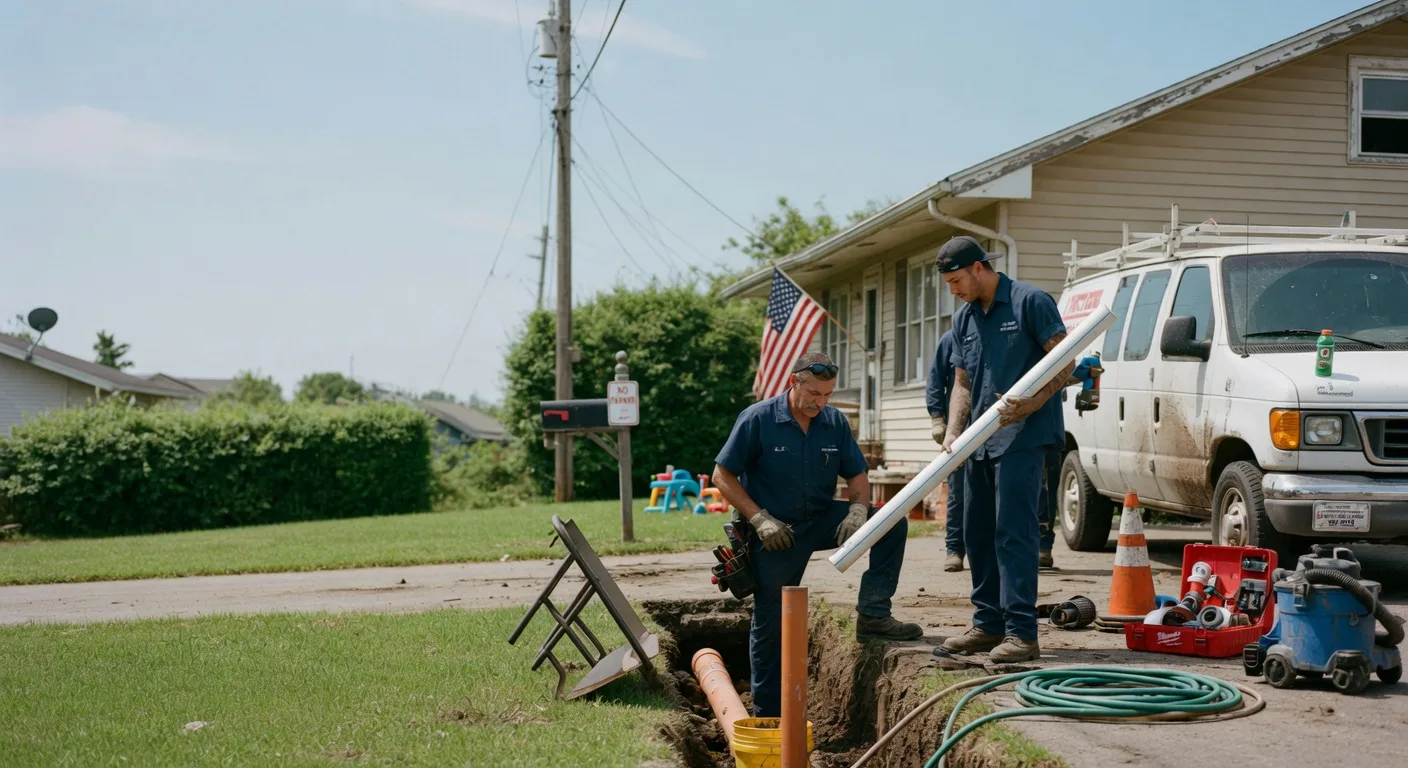
What is a bellied or sagging sewer line, and can it be cleaned?
A belly is a low spot in the sewer line where the pipe has sunk. Water and waste stop and sit in the dip instead of flowing on. Solids settle there, grease coats the pipe wall and paper catches. You see it as drains that run slow, a toilet that needs repeated flushing, or a line that clogs again a few weeks after it was cleared.
The cause is usually a pipe that lost support underneath it, or a joint that shifted.
Can it be cleaned? Yes, up to a point. A cable machine can open a blockage sitting in the belly, and hydro jetting can wash grease and buildup off the pipe wall. Neither fixes the dip. The belly keeps holding water, so the buildup returns.
A camera inspection tells you the rest. It shows how deep the belly is, whether the pipe is cracked, and whether roots have entered a joint. Cost depends on how deep the line is, how much has to be dug up or removed, the materials involved and any permit.
Safe homeowner check: note whether one fixture or the whole house is slow. One fixture points to its own branch. Every drain slow points to the main line.
Stop running water and call now if sewage is coming up in a tub, shower or floor drain.
Expert Plumbers Co is a referral service. Call (380) 262-9173 and we will connect you with a plumber serving Ingalls, MI for Drain Cleaning or Emergency Drain Cleaning.
Left alone, a belly tends to get worse in a predictable way. The standing water softens the soil around the pipe further, the dip deepens, and the clogs come back faster each time. Another warning sign is a faint sewage smell in the yard or a patch of lawn that sinks or stays wet, which can mean the pipe has separated at a joint. Older homes with clay or cast iron lines are the most likely to have a belly, because those pipes sit in sections and shift as soil settles. Newer plastic lines can also sag when the trench bedding was uneven. When you speak to the plumber, ask what the camera shows about the depth of the dip and the condition of the pipe at that spot. If the pipe is intact, a spot repair may be possible. If it is cracked, replacing that section is the lasting fix.
What is trenchless sewer repair and when is it an option?
You have been told the sewer line may need replacing, and you want to know if that means digging it all up. Trenchless repair avoids that. The plumber works from one or two small access pits, or from an existing cleanout, and either lines the old pipe from the inside or pulls a new pipe through the old path.
It is an option when the line is cracked, offset at a joint, or split by root intrusion at a clay joint, but still runs as one continuous pipe. Cast iron choked with scale can sometimes be lined too, after the scale is cleared. That usually means hydro jetting first, then a camera inspection to confirm the pipe condition.
It is not an option when the pipe has collapsed, when a bellied line holds water and the slope has to be corrected, or when sections are crushed or missing. A liner follows the old path, so a sag stays a sag. Those jobs need open excavation.
The camera inspection decides it. If the main line clogs again after every Drain Cleaning visit, the pipe may be failing, not just dirty.
Cost depends on how deep and how long the line is, how many access points are needed, the materials used, how much has to be opened up or removed above it, and any permit or code requirement. Expert Plumbers Co is a referral service, not a plumbing contractor. Call (380) 262-9173 and we will refer you to a plumber serving Ingalls, MI who can inspect the line.
Before any lining starts, ask the plumber to confirm where every side connection joins the main. Branches such as a second bathroom or a laundry line have to be reopened from the inside once the liner sets, and the camera run afterwards should show each one open. Tell the plumber about earlier backups, the age of the house and any past repairs, because older homes often have clay, cast iron and fiber pipe in the same run, and the liner has to bond to each. The finished pipe is slightly narrower inside, but its surface is smooth, so flow usually improves. Plan around laundry and showers while the liner cures, since the line cannot be used until it has set. Ask for the recording of the finished pipe and keep it with your house papers. It helps if you sell the home, and it shows the next plumber exactly what was installed and where it runs.
We run a cafe and the kitchen line keeps blocking. Is that the same job as a house drain?
Not quite. A kitchen line that blocks again and again is usually a grease problem, and that is a different job from a house drain.
A cafe pushes far more fat, oil and food solids down the pipe than a home does. The grease cools, sticks to the pipe wall and builds layer on layer. The opening shrinks each week. That is why the blockage returns on a short cycle.
A grease interceptor, also called a grease trap, sits between the kitchen and the main line. It catches fat before it travels downstream. It only works while it has room. Once it is overfull it stops holding grease and passes it straight into the line. So it needs servicing on a schedule, not just when something goes wrong. Many jurisdictions require an interceptor and expect records of each servicing. That is a code matter, so check with your local authority.
A cable machine punches a channel through the grease and leaves the coating on the wall. Water drains for a while, then the channel closes again. A commercial line usually needs hydro jetting, which uses high-pressure water to strip the wall clean. A camera inspection then checks the pipe underneath for cracks, roots or a sag that holds water.
One slow sink is a branch problem. Every fixture backing up points to the main line.
A blocked line in a food business is a shutdown risk, so timing matters. If water is rising near the prep area, stop using the sinks and call.
What the job involves depends on access to the line, how much has to be opened up, the condition of the pipe and any permit requirement. Expert Plumbers Co is a referral service. Call (380) 262-9173 and we will refer your cafe to an independent local plumber in Ingalls, MI.
Keep a servicing record and a routine. Write down the date each interceptor is serviced and by whom. Authorities that require interceptors usually ask to see those records.
Train kitchen staff on what goes down the drain. Scrape plates and pans into the trash first, fit fine mesh strainers in every sink, and never pour fryer oil down any drain, even with hot water, because it cools further down the line and sets. Hot water and soap only move grease along the pipe. They do not remove it.
Learn the warning signs of a full interceptor: slow draining at the sinks nearest it, a sour or rancid smell, or grease showing in the outlet chamber.
Set the jetting interval after a camera inspection shows how fast the coating builds, so cleaning happens before a lunch rush is lost to a backup. Mention any recent menu change toward fried or fatty food when you call.
What should I tell the plumber on the phone so the right equipment turns up?
Describe what the water is doing and how often it has happened. Those two details decide which tool is needed.
When you call Expert Plumbers Co, a referral service, we ask the same questions. The answers shape the referral to an independent local plumber.
One fixture or every drain? One slow sink is a branch line, and a cable machine often handles it. Every drain backing up points to the main line or a blocked vent stack, which is a bigger job.
Is water rising, or just slow? Rising water means the line is nearly shut. Say so first.
Does anything gurgle when another fixture runs? Gurgling suggests a blocked vent stack or a partial blockage in the main line.
How long has it been happening, and has it been cleared before? A repeat blockage points to a fixed fault, such as root intrusion at a clay joint or a bellied line holding water. Another cable run only buys time. That is a camera inspection case.
Is there a cleanout, and roughly where? Access changes how the equipment gets in.
What is the pipe made of, and how old is the house? In older housing stock, clay and cast iron are common. Clay joints let roots in. Cast iron can scale up inside.
Septic tank or city sewer? A septic system changes where the problem can sit and which tool is safe to use.
Basement or slab? A basement often gives a lower access point. A slab can mean opening the floor or working from outside.
What the work involves depends on access, the pipe materials, how much has to be opened up and any permit or code requirement. Call (380) 262-9173 and we will refer you to an independent local plumber in Ingalls, MI.
Have a few practical things ready before the plumber arrives. Clear a path to the cleanout, the basement or the crawlspace, and move stored items out of the way. Know where the main water shutoff is and be ready to show it.
If you can, take a short phone video of the symptom, such as water rising in a tub when the washer drains. Intermittent problems often vanish by the time anyone arrives, and a video shows what the water was doing.
Mention anything poured down the drain recently, including chemical cleaners. Those affect which tools can be used safely, and the plumber needs to know before reaching into the line.
Say if pets or small children are in the home, and keep your phone nearby, because the plumber may call to confirm the address and access details. Answers ready on the first call shorten the visit and help the right equipment arrive the first time.
I rent out my place and the tenant says the drains are backing up. What should I ask them, and what should I arrange?
Start with a few plain questions, because the answers tell the plumber where the problem is before anyone arrives.
Ask the tenant which fixtures are affected. One slow sink or tub points to a clog in that fixture's own branch. If several drains are slow, or water rises in a tub or shower when the toilet is flushed or the washer empties, the main line is the likely culprit.
Ask when it started and what changed. Did it follow heavy rain, a laundry day, a large gathering, or a new habit such as flushing wipes? Ask whether there are gurgling sounds, a sewage smell, or water in a floor drain or basement. Ask whether anything has already been tried, especially chemical cleaners, since those are a hazard to whoever opens the pipe next.
Ask for photos or a short video of the fixtures. That is faster than a long phone call and helps if you are not living nearby.
What to tell the tenant right away: stop running the washer and dishwasher, go easy on the toilets, and do not pour cleaner down the drain. If sewage is coming up inside the home, or water is spreading across a floor, treat it as urgent and keep people and pets out of the wet area.
What to arrange: a plumber to clear the line and, if the same drain has failed before, a camera look at it. Offer the plumber the tenant's contact details and agreed times so access is not the delay. Ask whether the blockage was in the fixture branch or the main line, and whether the plumber thinks it was caused by tree roots, a sagging pipe or something that was flushed. That tells you whether it is a one-off or a repair item.
Keep notes: dates, photos, what the plumber found. Whether the cause is wear or misuse affects the conversation with the tenant, so write down what was seen rather than what was assumed. Check your lease and local rules for your own obligations.
Expert Plumbers Co can connect you with an independent plumber in Ingalls, MI for this: call (380) 262-9173.